What Impact Did 2025 Tax Credit Purchases Have on Effective Tax Rates?
The third of five data-driven posts exploring how companies are participating in the transferable tax credit market.


Reunion's analysis of public company filings shows that nearly 80% of companies purchasing transferable tax credits in 2025 lowered their effective tax rate (ETR) by between 0.4 and 2.0 percentage points.
We analyzed over 6,000 public filings across approximately 1,400 of the largest U.S. public companies to quantify the impact of tax credit purchases on effective tax rates. ASU 2023-09, a new accounting standard in effect for fiscal years beginning after December 15, 2024, requires more granular tax disclosures by public companies and makes credit purchases easier to verify.
The Typical Reduction: 0.4 to 2.0 Percentage Points
For a company paying a 23% effective rate, a typical credit purchase might bring that down to somewhere between 21% and 22.6%. In cash terms, a company with $1B in pre-tax income can save $10M in cash when reducing its ETR by 1 percentage point – which it can do by purchasing tax credits at a discount to face value.
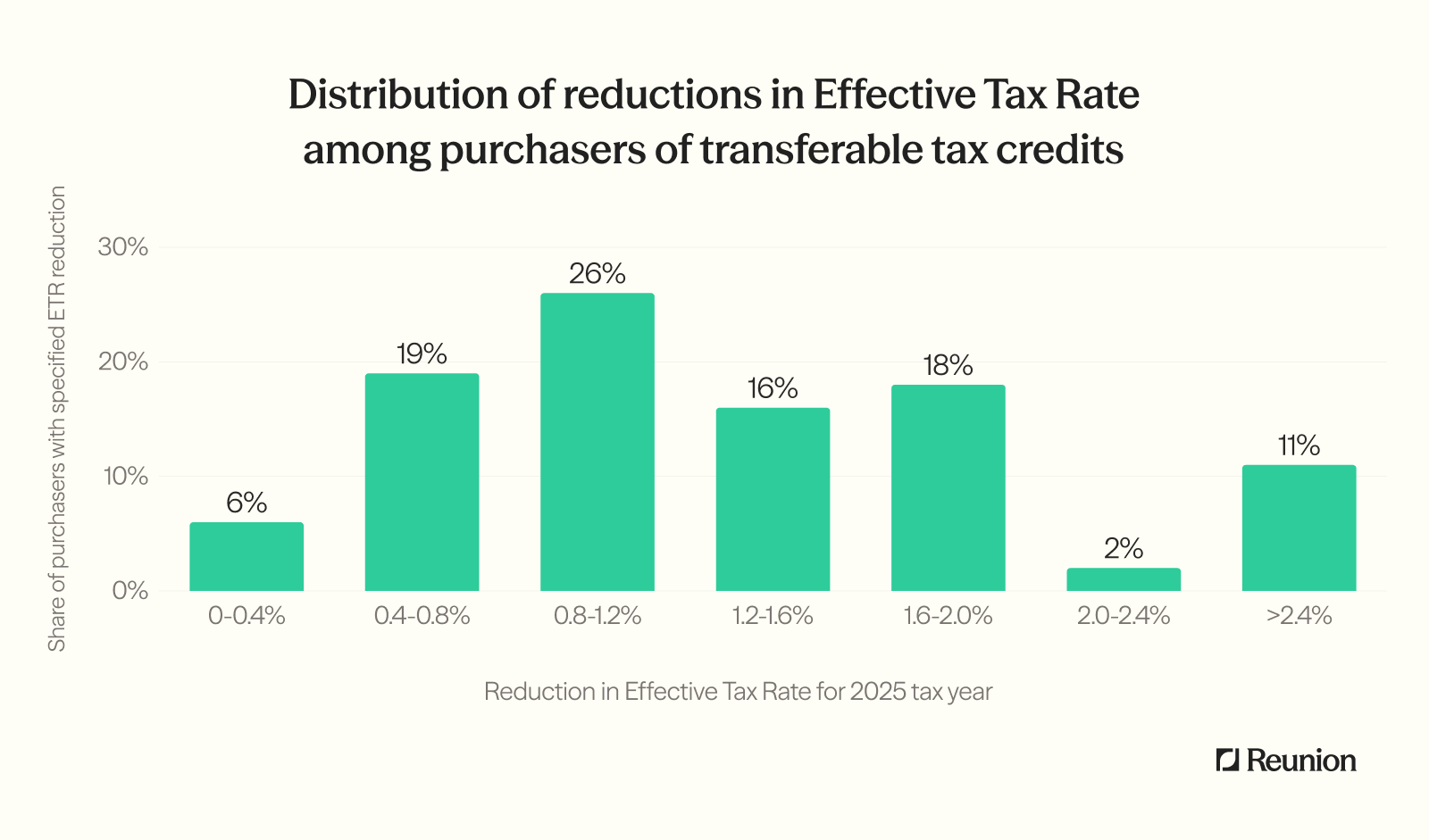
This range reflects the economics of how most companies size their credit purchases: large enough to generate meaningful tax savings, but not so large as to create concentration risk with a single credit type or project.
What Is the Upper End of the ETR Reduction Range?
A smaller group of companies reported ETR reductions exceeding 5.0 percentage points – companies that made particularly large credit purchases relative to their overall tax liability. These are often mid-size companies where a single credit transaction represents a material share of total tax expense.
Key Takeaway
The 0.4–2.0 percentage point range provides a useful benchmark for companies evaluating their transferable tax credit purchase strategy. The clustering of reductions in this range suggests that the buyers have largely converged on sizing transactions to produce meaningful yet manageable impacts on their tax positions – neither making token purchases nor going all-in.
Transferable tax credit purchases are producing real, measurable reductions in effective tax rates for the companies that buy them. For companies with significant federal tax liabilities and effective rates near the statutory rate, this represents a new and accessible lever for tax optimization.
For the next post that explores the geographic incidence and spread of tax credit purchase rates, click here. For the full series, start here.
Reunion maintains a database of public companies that have disclosed transferable tax credit purchases, available to entities buying or selling credits, and provides exclusive access to the underlying SEC data to existing buy-side and sell-side clients of Reunion. Reach out to your Reunion contact for access.
Data Notes
Analysis Period: February-March 2026
Universe: ~1,400 largest U.S. public companies
Filings Reviewed: 10-K, 10-Q, 20-F, 40-F filed since January 1, 2025
Methodology:
- Credit Classification: Many filings reference transferable credits without specifying type. These are classified as clean energy credits since transferability is generally tied to Section 6418.
- Sample Composition: Of approximately 1,400 companies, roughly 1,000 had filed both 2024 and 2025 reports during the analysis window. The remainder had not yet filed 2025 reports or had 2024 filings published before data collection began.
- Data Quality: An AI-assisted process was used to scan filings. All identified purchasing activity was then human-verified at the company level.

