What Companies Subject to the BEAT Should Know When Buying Tax Credits
In the August 2026 issue of Tax Notes Federal, Moon and Cannon examine the base erosion and antiabuse tax, including how energy transition credits are treated under it.

.jpeg)
In the realm of energy tax credits, special rules apply to U.S. companies that are subject to the corporate minimum tax known as the base erosion and antiabuse tax.
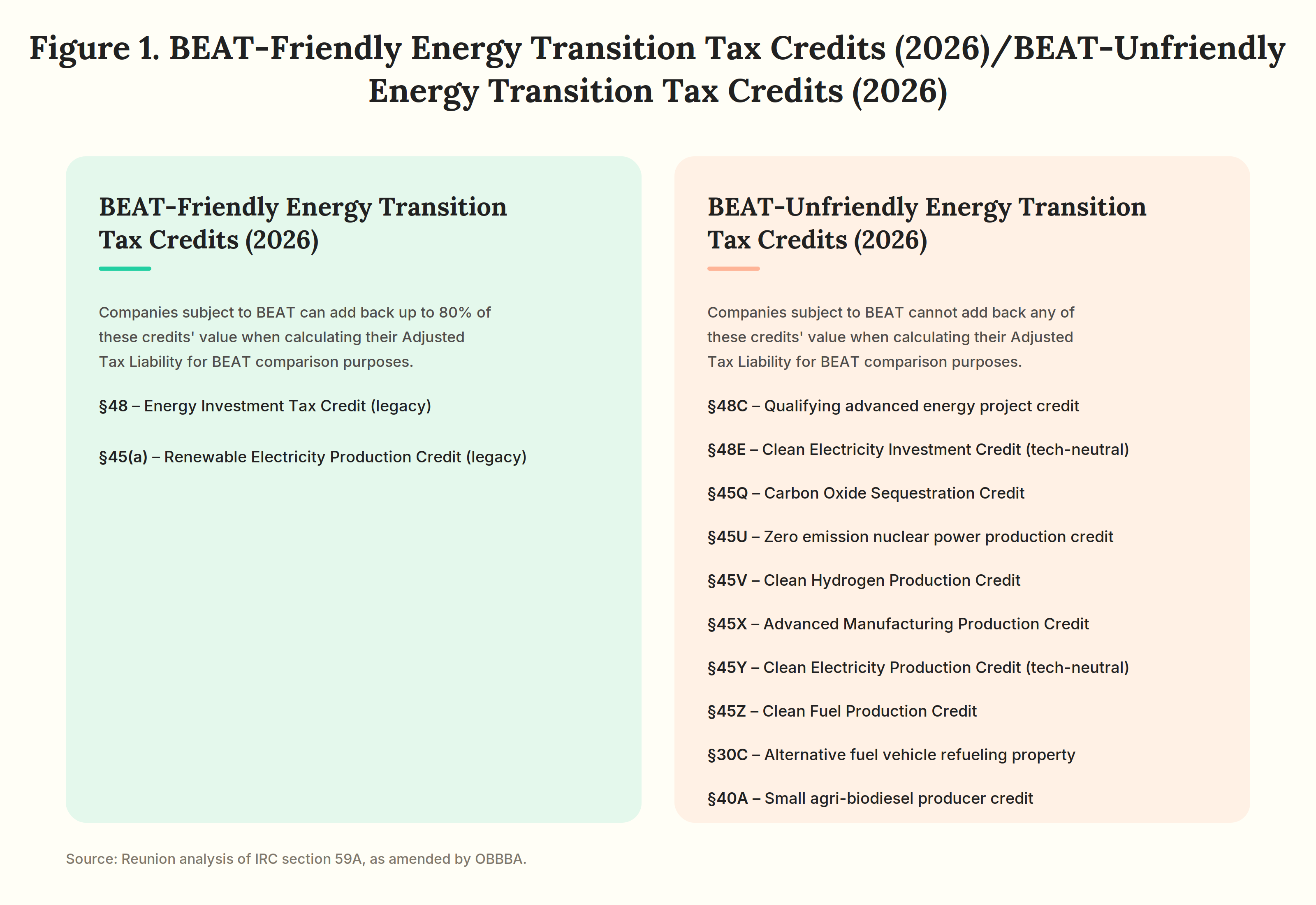
Certain energy transition credits, namely legacy section 45(a) production tax credits (PTCs) and section 48 investment tax credits, are treated favorably when calculating BEAT because up to 80 percent of the credit value can be added back.1 Other energy transition credit types, including section 45Y, 48E, 45Q, 45X, and 45Z credits, are not treated favorably when calculating BEAT.
What Is BEAT and Who Is Subject to It?
BEAT was enacted as part of the 2017 Tax Cuts and Jobs Act to prevent large multinational corporations from eroding their U.S. tax base by shifting profits to foreign affiliates.
BEAT applies to any corporation (other than a regulated investment company, a real estate investment trust, or an S corporation) that meets two criteria:
- Revenue threshold: Average annual gross receipts of at least $500 million over the preceding three years (tested on an aggregated basis across the single-employer group under section 52(a) and, for any foreign corporation in the group, only factoring in gross receipts effectively connected with a U.S. trade or business).
- Base erosion percentage: The taxpayer’s base erosion percentage is at least 3 percent (2 percent for a taxpayer in certain affiliated groups that include a bank or a registered securities dealer). Broadly, that percentage is the taxpayer’s base erosion tax benefits as a share of its deductions for the year, subject to statutory exclusions.2
BEAT functions as a minimum tax, and companies that meet both thresholds must calculate their BEAT liability every year. If a company’s regular U.S. federal income tax liability, as adjusted for credits under the BEAT rules, falls below the calculated BEAT level, then the company must pay the difference as a top-up.
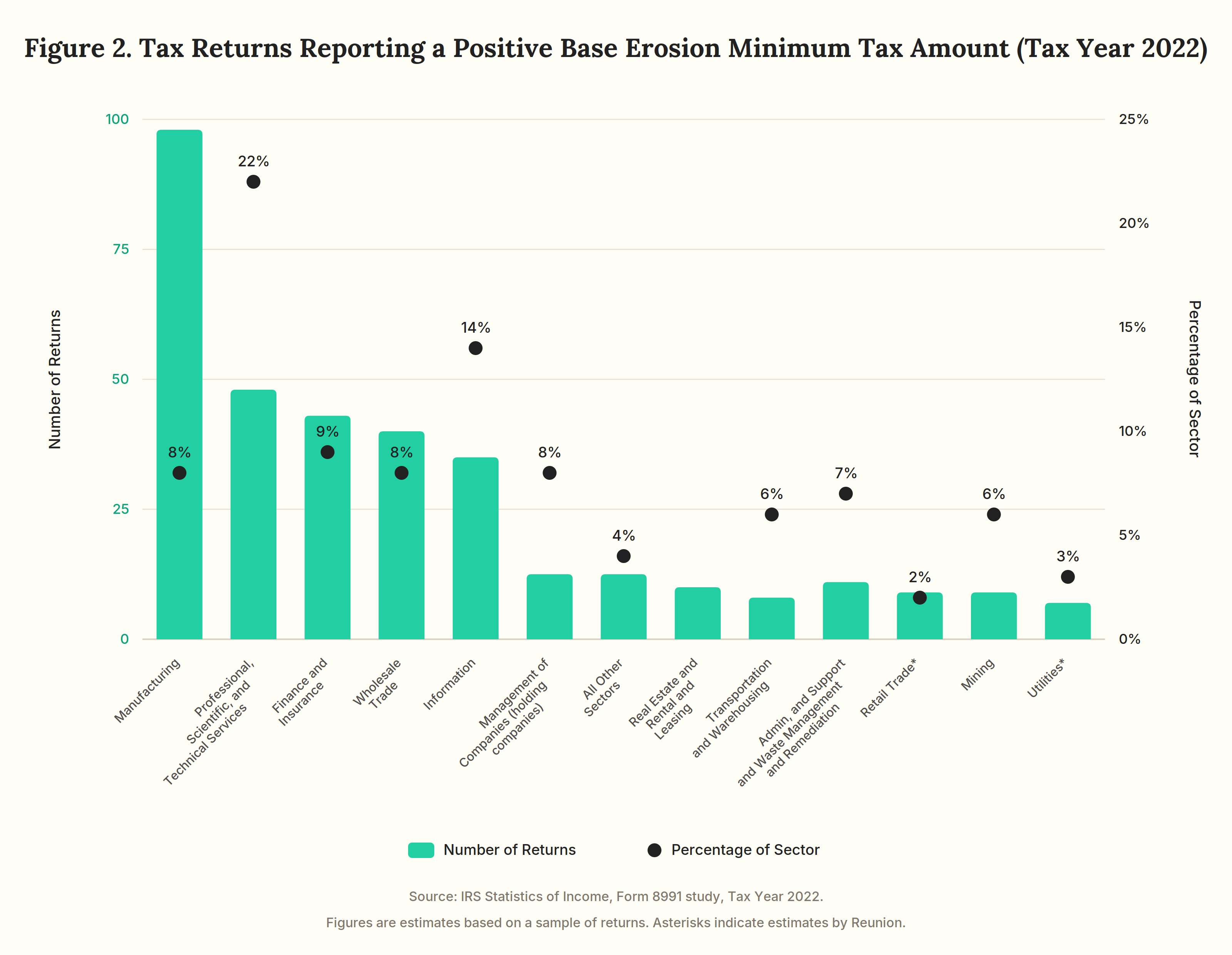
The IRS’s most recent available data about BEAT is for the 2022 tax year.3 That year there were 324 returns in the IRS Statistics of Income data (Form 8991, "Tax on Base Erosion Payments of Taxpayers With Substantial Gross Receipts") that reported a base erosion minimum tax amount, requiring filers to "top up" their regular tax liability.
Defining Key Terms to Calculate BEAT
The following terms are necessary to understand BEAT calculations and the examples that follow:
- Base erosion payments: Tax-deductible payments made by a taxpayer to a foreign related party. These payments are often used by multinational companies to shift profits out of the United States, lowering their tax bill.4
- Modified taxable income: The sum of regular taxable income and an add-back of deductions associated with base erosion payments to foreign-related parties.5
- Preliminary BEAT: Modified taxable income multiplied by the BEAT tax rate (10.5 percent for tax years beginning after December 31, 2025; 11.5 percent for a taxpayer in certain affiliated groups that include a bank or registered securities dealer).6
- Applicable section 38 credits: Credits that are treated favorably (a capped and fact-dependent benefit) in the BEAT calculation:7
- low-income housing credit determined under section 42(a);
- renewable electricity production credit determined under section 45(a); and
- investment credit determined under section 46, but only to the extent properly allocable to the energy credit determined under section 48.
- Adjusted tax liability: Regular tax liability minus credits plus credit addback (as defined in the next section below).8
BEAT Formula
Companies subject to BEAT can use the following sets of equations to determine the BEAT payment due:
In summary, if the preliminary BEAT is larger than adjusted tax liability (B - C + D), then there is a BEAT payment due to top up taxes to meet the preliminary BEAT. Otherwise, the BEAT payment due is zero.
Numerical Assumptions for Three Sample Calculations
Let’s assume that a company has the following characteristics:11
- $2,000 million in gross income before the deductions listed below;
- $1,400 million in deductions not attributable to base erosion payments;
- $100 million in current-year deductible base erosion payments;
- regular taxable income of $500 million ($2,000 million - $1,400 million - $100 million);
- regular tax liability of $105 million (21 percent * $500 million);
- Modified taxable income of $600 million ($500 million + $100 million); and
- preliminary BEAT of $63 million (10.5 percent * $600 million).
Example 1: Effect of BEAT-Unfriendly Credit Purchase
The company purchases $72 million in section 45Z clean fuel production credits. Because this is not a BEAT-friendly credit, it cannot be included as a credit addback in the BEAT calculation:
In this example, adjusted tax liability (B - C + D) is below preliminary BEAT, and the company has to pay a $30 million BEAT top-up payment. Ultimately, the company pays a total tax payment of $63 million instead of the regular tax liability of $105 million.
Assume that the company paid $65 million for their $72 million of tax credits (about $0.90 per credit). In this case, they paid $65 million to achieve only $42 million in tax savings ($105 million - $63 million). Given that the purchase price is nondeductible to the buyer,12 the result is a net cash loss of $23 million ($42 million of current-year tax reduction minus the $65 million paid).
Example 2: Effect of BEAT-Friendly Credit Purchase
This time, the company purchases $72 million in section 45 legacy PTCs, which are a BEAT-friendly credit. Therefore, the company can add back up to 80 percent of the credit value in its calculation of adjusted tax liability.
Because legacy section 45 credits are BEAT-friendly, the $24 million credit addback raises adjusted tax liability (B - C + D) to $57 million, versus the preliminary BEAT amount of $63 million. Therefore, the company must pay a $6 million BEAT top-up tax, which is significantly less than the $30 million top-up that was required in the previous example with BEAT-unfriendly credits.
Assuming, as in Example 1, that the company paid $65 million for $72 million of credits, the company has paid $71 million ($65 million in credit purchase price + $6 million in BEAT top-up) to offset $72 million in regular tax liability. Put differently, the company’s total cash outlay is $104 million ($33 million of regular tax remaining after credits, plus the $6 million BEAT top-up, plus the $65 million purchase price), as compared with the $105 million of regular tax liability assuming no purchase. The result is a net cash benefit of about $1 million.
Example 3: Credit Purchase Sized to Maximize Economic Benefit
This time, the company purchases $42 million in section 45(a) legacy PTCs. At this quantity of credit purchasing, the company does not owe a BEAT top-up and realizes the highest net economic value from credit purchasing.
In this example, the buyer purchases credits up to the value at which adjusted tax liability is equal to preliminary BEAT, resulting in zero BEAT top-up payment. By purchasing the maximum amount of credits possible while avoiding a BEAT top-up payment, the company is able to realize the full economic benefit of the $42 million credit purchase.
The $42 million credit purchase in this example comes solely from BEAT-friendly section 45 legacy PTCs, but the buyer would also avoid a BEAT top-up with a similarly sized purchase of any other transferable credit type, including BEAT-unfriendly energy credits such as section 45Z or 48E credits.
Assuming a price of $0.90 per credit (approximately the price in examples 1 and 2), the company paid $37.8 million to achieve $42 million in tax savings ($105 million - $63 million). The result is a net cash benefit of about $4.2 million. For the buyer in our example, this credit purchase volume delivers the maximum economic benefit at this price.13
Key Takeaways
Tax Credit Buyers Should Model BEAT Treatment Explicitly
When subject to BEAT, the economic gain and loss from a credit purchase can vary substantially based on both the company’s tax circumstances and the type and volume of credit the taxpayer chooses to buy. The BEAT top-up tax can cause the taxpayer to experience an economic loss from purchasing credits, particularly when purchasing a high volume of BEAT-unfriendly credits.
‘BEAT-Friendly’ Section 45(a) and Section 48 Credits Can Reduce Risk
Purchasing BEAT-friendly credits can reduce BEAT top-up payments through a credit addback, as shown in Example 2. Of all the energy transition tax credits, the One Big Beautiful Bill Act preserved an 80 percent addback for section 45(a) and section 48 credits only. Newer credits, such as sections 45Y, 48E, 45Q, 45X, and 45Z, do not benefit from this treatment.
Tax Credit Purchases Can Be Sized to Maximize Economic Benefit
The maximum volume of credits (without regard to section 41 research credits) a taxpayer can use in the current year without incurring a BEAT top-up payment is equal to regular tax liability minus preliminary BEAT (assuming regular tax liability exceeds preliminary BEAT before any credit purchase).14 This equalizes preliminary BEAT and adjusted tax liability, resulting in zero BEAT top-up tax as shown in Example 3.15
As long as a taxpayer has zero BEAT top-up tax, the taxpayer benefits equally from BEAT-friendly and BEAT-unfriendly credits. That said, companies do not always have full visibility into what their regular tax liability will be at the time they purchase credits; purchasing BEAT-friendly credits will help mitigate the downside risk illustrated in Example 1.
Understand BEAT Exposure Before Credit Transaction
Only a company that is already an applicable taxpayer (a status tested on an aggregate-group basis), with its own base erosion payments, computes BEAT at all. While IRS statistics estimate that only a few hundred returns reported a positive base erosion minimum tax amount for tax year 2022, many more companies meet thresholds that put them at risk. For these companies, tax credit selection matters.
Notes
1. Section 59A(b)(3); see also section 59A(b)(1)(B)(ii)(II), the operative provision applying the 80 percent addback cap. Certain non-energy credits are also subject to favorable treatment. See 'Applicable section 38 credits' above.
2. Section 59A(c)(4), (e)(1)(C), and (b)(2)(B).
3. IRS, "SOI Tax Stats — International Tax Studies Based Upon Provisions Introduced by the Tax Cuts and Jobs Act (TCJA) of 2017" (last updated Sept. 25, 2025).
4. This is a simplified description. Section 59A(d) also reaches, among other things, amounts paid to a foreign related party to acquire depreciable property and is subject to statutory exceptions.
5. Under section 59A(c), modified taxable income also adds back the base-erosion percentage of any net operating loss deduction; the examples later in this article assume none.
6. Treasury has not conformed the regulations to the One Big Beautiful Bill Act. By its terms, reg. section 1.59A-5 applies a 12.5 percent rate for tax years beginning after December 31, 2025, and states credit-protection rules limited to tax years beginning on or before December 31, 2025.
7. Section 59A(b)(3); section 59A(b)(1)(B)(ii)(II) (the operative provision applying the 80 percent cap).
8. "Adjusted Tax Liability" is this article’s label for the comparison amount described in section 59A(b)(1)(B).
9. Section 59A(b)(1)(B).
10. The formula assumes that all the company’s credits are general business credits allowed under section 38 for the tax year, after the section 38(c) limitation and the section 38(d) ordering rules. If a taxpayer has multiple general business credit components, section 38(d)(1) treats credits as used in the order in which they are listed in section 38(b), which determines how much of each component is allowed for the year.
11. We have also assumed each of the following for tax years starting in 2026: (1) that the company is not a member of an affiliated group (as defined in section 1504(a)(1)) that includes a bank or a registered securities dealer, so the ordinary 10.5 percent rate applies, see section 59A(b)(2)(A)-(B); (2) the credit amounts shown are the amounts allowed under section 38, after the section 38(c) limitation and any section 39 carryovers, and are the company’s only general business credits, see section 38(a) and (c); (3) modified taxable income reflects the adjustments required by section 59A(c); (4) to the extent a credit is purchased, a valid section 6418 transfer election applies, under which the transferee is treated as the taxpayer regarding the credit, see section 6418(a); (5) no section 55 corporate minimum tax applies; and (6) the company is an applicable taxpayer under section 59A(e), including average annual gross receipts of at least $500 million for the previous three-year period on an aggregate-group basis.
12. Section 6418(b)(3).
13. Credit pricing is relevant to this conclusion. Past the no-top-up boundary, each additional dollar of BEAT-friendly credit reduces regular tax by $1 while increasing the BEAT top-up by only $0.20 (because of the 80 percent capped addback), a net $0.80 reduction in total federal tax. Therefore, buying BEAT-friendly credits beyond the boundary would remain profitable at a price below $0.80.
14. This is a limit on current-year use, not on purchases. A transferee that buys more than it can use in the year may carry the excess forward as a general business credit (although a seller cannot transfer its own carryforwards to a buyer).
15. As noted in Example 3, it is possible to achieve additional economic benefit by purchasing BEAT-friendly credits at a price lower than $0.80, given that the BEAT top-up tax will be less than the benefit delivered by the credits.
Andy Moon is the co-founder and CEO of Reunion, a platform for clean energy tax credit transfers and compliance, where Nathan Oalican is chief of staff. Michael Q. Cannon is a partner in the Dallas office of Gibson Dunn & Crutcher LLP. They thank Josiah Bethards for helpful comments on an earlier draft.
Reprinted from Tax Notes Federal, August 31, 2026, p. 1597. Copyright 2026 Andy Moon and Michael Q. Cannon. All rights reserved.
© 2026 Tax Analysts. All rights reserved. Tax Analysts does not claim copyright in any public domain or third party content.

