10 million solar panels? 75,000 EV batteries? How we think about Reunion’s impact.
Sizing up a tax credit facilitator’s role in the clean energy economy


As experts in tax credits, we spend our time negotiating transactions, conducting due diligence, and building the software infrastructure to facilitate project finance. Behind every tax credit a physical project: real-world infrastructure that generates clean electricity, stores energy, manufactures critical components, and more. Over the past few months, we set out to measure the scale of these projects in terms of their environmental and energy impact.
A word on scope before we get into the numbers: Reunion is not a project developer or manufacturer. We do not build the projects, employ the laborers, or generate electricity. Instead, we play an integral role in financing clean energy infrastructure by facilitating the sale of tax credits. In a project that is eligible for investment tax credits, for example, the proceeds from a tax credit sale can provide 30, 40, or even 50% of the upfront capital for a project. Selling or monetizing the credits is critical to getting the project built.
The figures below reflect the scale of projects we've been associated with, and helped advance; we think that distinction matters, and we've tried to be precise about it throughout our analysis.
Starting With the Data
Our analysis began with a detailed review of all deals Reunion has helped close since beginning this work in 2023. We catalogued project-level metrics related to energy output and environmental outcomes, including values such as megawatt-hours of generation, megawatts of installed capacity, metric tons of manufactured components, energy storage capacity, and mass of carbon dioxide emissions avoided. From there, we built a methodology using state-level emission rates, capacity factor assumptions, and other conversion factors to translate raw project data into tangible impact metrics.
A few principles guided us throughout our analysis:
- Use defensible, conservative assumptions. Where there was ambiguity (e.g., in capacity factors, emission rates, or energy storage duration) we defaulted to a conservative estimate.
- Avoid double-counting. Some projects touch multiple credit types or multiple metrics. To avoid overstating impact, we simply omitted projects that posed a risk of duplicating or distorting results.
- Use established data sources. Analogies between project-level statistics and relatable impact metrics (e.g., electricity generation equivalent to the annual combined usage of New Hampshire and Rhode Island) are only useful when underpinned by good data. We sourced benchmarks from best-practice sources such as EPA eGRID data and the U.S. Energy Information Administration.
Measuring the Impact of Projects
Generation: Solar, Wind, and Biogas (Production Tax Credits)
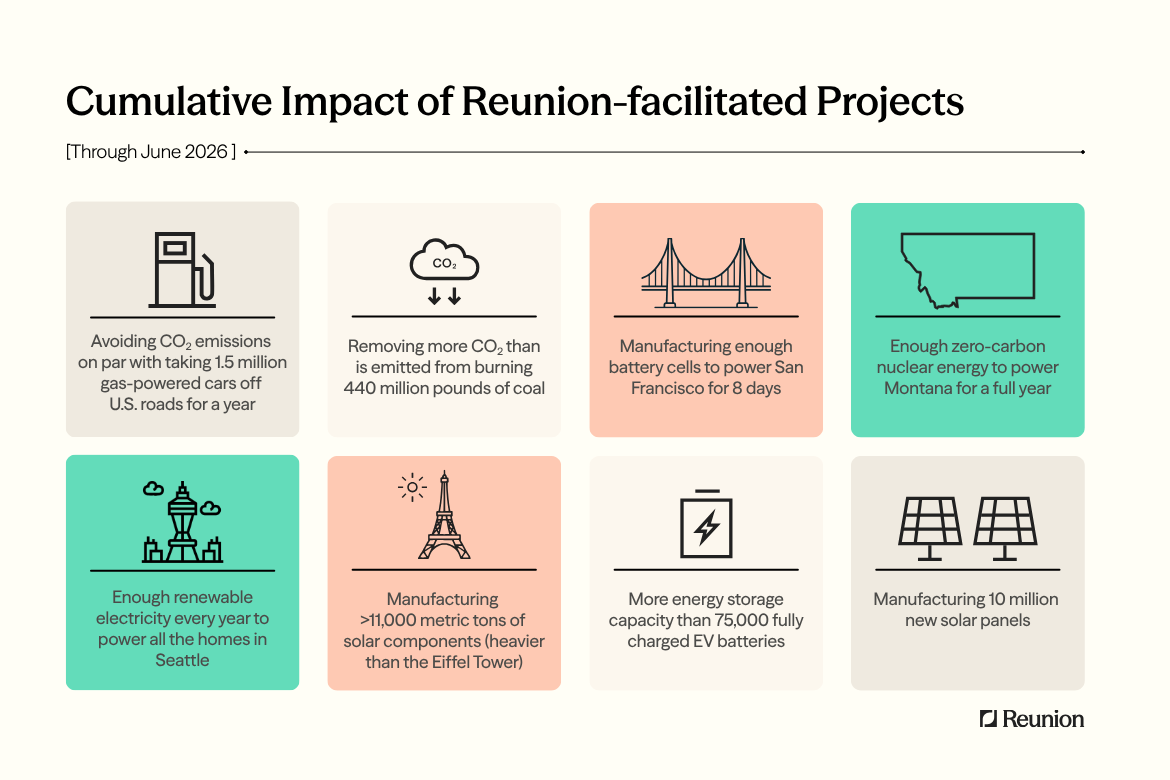
To date, the aggregate energy production across solar, wind, and biogas projects supported through §45 Production Tax Credits in our portfolio has totaled 18.6 million megawatt-hours of clean electricity. That’s roughly the annual electricity use of 1.8 million US households, or the total annual consumption of New Hampshire and Rhode Island combined.
Using state-level EPA eGRID emission rates, which account for the actual carbon intensity of the grid in each state where these projects operate, this 18.6 million MWh of generation translates to approximately 6.46 million metric tons of CO₂ equivalent avoided.
For context, that's on par with eliminating the annual emissions of 16 natural gas plants, reducing gasoline consumption by 725 million gallons, or taking 1.5 million cars off America’s roads.

Installed Generation Capacity: Primarily Large-Scale Solar (Investment Tax Credits)
Many projects in our portfolio are utility-scale solar installations supported by the §48 Investment Tax Credits. These alone represent more than 1,800 MW of installed clean energy capacity across 3.6 million solar panels at ~500 watts per panel. Assuming a 20% capacity factor for utility-scale and commercial solar, these projects are expected to generate roughly 3.2 million MWh of clean electricity annually — enough to power the electricity use of all homes in Seattle.

On an ongoing emissions basis, that output avoids an estimated 1.07 million metric tons of CO₂ equivalent per year, the same as planting 17 million urban tree seedlings annually with each tree soaking up carbon for a decade.
Although we have facilitated investment in several residential solar projects, we omitted these from our impact analysis to avoid mixing emission rates across multiple states, and because the prevalent coupling of residential systems with energy storage creates additional measurement complexity.
Installed Energy Storage Capacity (Investment Tax Credits)
Our deal portfolio has also included several large-scale energy storage projects supported by §48 Investment Tax Credits. These projects have added up to more than 1,350 MW of deployed storage capacity. Assuming a standard four-hour discharge window, that represents roughly 5,400 MWh of dispatchable storage capacity — the equivalent of more than 75,000 EV batteries. Storage at this scale is essential infrastructure for a grid that runs on variable renewables, and this number reflects the role tax credit finance plays in making it viable.

Advanced Manufacturing: Solar Panels and Components
Our deal portfolio of §45X Advanced Manufacturing Tax Credits includes the manufacture of more than 5,000 megawatts of solar modules or about 10 million solar panels. That’s more solar panels than were installed across the entirety of California in 2025, and greater than 10% of all solar capacity installed in the U.S. that year.

In addition, our portfolio included a large project to manufacture an esoteric solar component known as torque tubes. These are hollow metal tubes that rotate to allow solar panels to track the sun’s position throughout the day, thereby maximizing energy output.
The large-scale production of these torque tubes amounted to more than 11,000 metric tons of structural components. That’s heavier than the Eiffel Tower, which weighs in at a mere 10,100 metric tons.

Advanced Manufacturing: Battery Cells
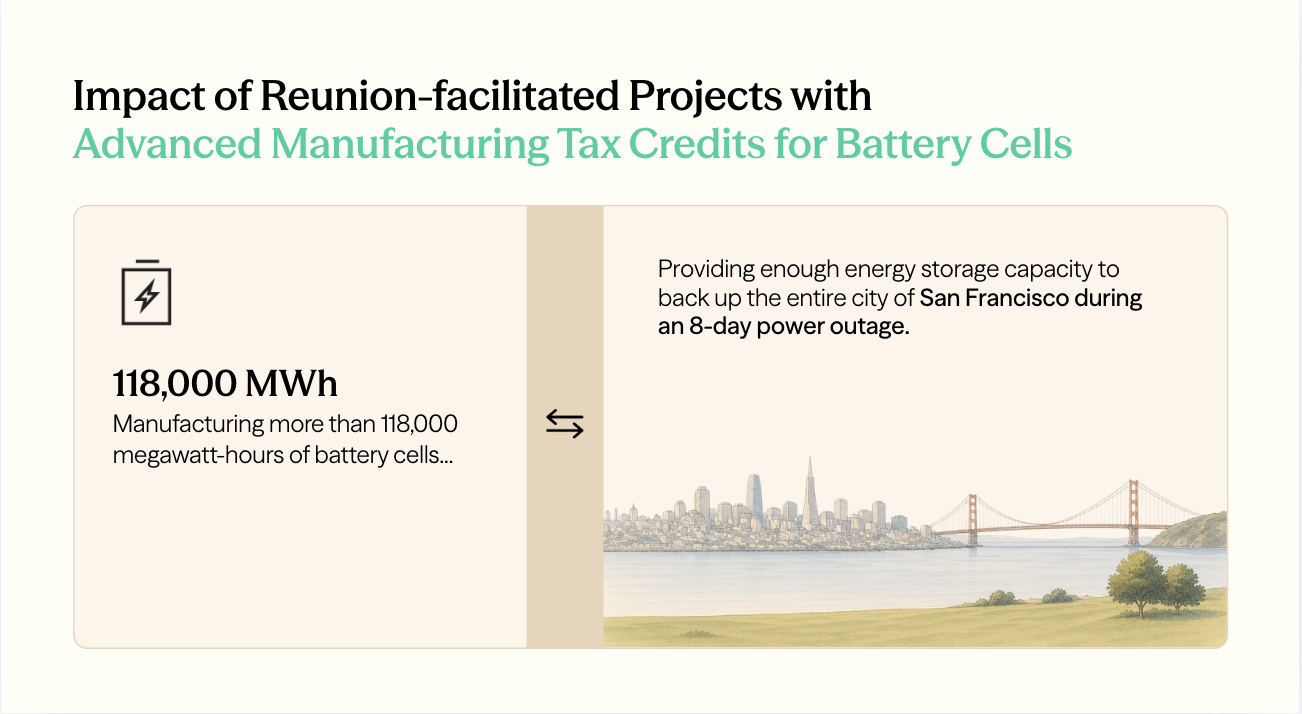
On the battery side of §45X Advanced Manufacturing Tax Credits, we looked specifically at projects that produce battery cells — the core electrochemical unit that makes energy storage fundamentally possible. Although some projects produced other battery-related components, we omitted those from our impact analysis because of their secondary importance. Across our deal portfolio, we identified manufacturing projects producing 118,486 MWh of battery cell capacity, enough backup electricity to power the entire city of San Francisco during an 8-day power outage.
Carbon Removal
Our portfolio now also includes large-scale carbon sequestration projects supported by the §45Q tax credit. These projects capture more than 400,000 metric tonnes of carbon dioxide annually from industrial processes, prevents its release into the atmosphere, and store it permanently underground. For context, this is equivalent to the carbon sequestered by 400,000 acres of U.S. forests in one year, or the avoidance of roughly 440 million pounds of coal burned.

Critical Minerals
Decarbonization technologies depend on a reliable supply of critical minerals: raw materials considered essential to the economy and vulnerable to supply disruption. Our §45X deal portfolio spans projects developing $2.3 billion worth of critical minerals. Around two-thirds of this portfolio is in the form of projects recovering platinum-group metals from recycled materials; these specialty materials underpin everything from fuel cells to green hydrogen production.

Nuclear
Finally, our deal portfolio includes a large amount of electricity production based on the §45U Zero-Emission Nuclear Power Production Credit. Projects that we have facilitated preserved 15.8 million MWh of nuclear output, an amount of zero-carbon generation that is commensurate with the annual electricity use of Montana.

Why This Kind of Accounting Matters
At Reunion, we facilitate tax credit transactions and compliance. Tax credits have been an essential part of financing clean energy infrastructure; without it, many of the projects otherwise would not be built.
By making project finance more efficient and accessible, Reunion plays a humble role enabling the essential work of developers, manufacturers, operators, and construction workers building the future of our energy system. Every credit we facilitate is attached to a real asset, real workers, and real tons of carbon kept out of the atmosphere. Keeping that connection legible is ultimately what makes this work matter.
Additional methodology notes:
- When doing equivalency calculations with the EPA Greenhouse Gas Equivalencies Calculator for electricity generation, we adopted the more conservative input option of “kWh Used,” rather than “kWh avoided.”
- Dollar-denominated output for Critical Minerals is based on verified sales figures from tax credit sellers.
- We adopted an average of 70 kWh for EV battery capacity, based on the ranges provided by the EV marketplace Recharged.

