Finance with a Mission: Q&A with Connie Chern, Head of Transactions at Reunion
Reunion’s Head of Transactions on building a career in clean energy finance, leading through trust, and how to fill a sketchbook


How did you get into clean energy finance and what’s kept you there?
The year before I graduated college, I interviewed with Novogradac & Company — a mid-size accounting firm. The thing I really loved about them is that they would allow me to do audit as well as tax, and they were focused on things that I felt good about spending time on — tax-advantaged investments, low-income housing, new markets tax credits, and then later, renewable energy tax credits.
From there on out, my journey has largely focused on renewables. It's something I'm highly passionate about, and I think you don't always get the opportunity to spend your career doing things that are also personally motivating. That's really what drew me to it and what's kept me in it.
Besides mission, what else has drawn you to the places you’ve worked, including Reunion?
I'd say the ability to be innovative. I'm one of those people who probably thrives at a startup, where there's a little bit more ambiguity, and where each individual can make an outsized impact. I think it could also be a strong desire to continue learning.
After running your own company (Orka Finance) for a few years, one might expect you’d take a break. You didn't.
I wasn't actually sure what I wanted to do next after we sold Orka. I had originally thought I would take some time off — do the gap year thing. I'd basically never taken time off. I had always just been go, go, go.
At a friend’s urging, I casually did a networking lunch with [Reunion Cofounder] Billy because he's local in San Francisco, which is where I'm located. And I think what really struck me — about both Billy and Reunion’s other founder Andy — was their ability to move quickly to identify potential problems or opportunities.
It was also a space I'm passionate about. The idea that you could sell a clean energy tax credit on the open market was a breakthrough, and Reunion was making it happen at scale. I'd spent a lot of my career telling people, "I know you want to own these assets, but you're not able to use a tax credit, and I just don't know that the tax equity market will help fund your project. There's a lot more supply of credits than there is demand." That's a painful thing to tell someone. So this really changed the game.
As much as I wanted to do more soul-searching or backpack somewhere, I ended up joining Reunion on my very first day that I was no longer bound to another company.
You now lead one of Reunion's largest teams. How do you think about your role as a manager?
We have a team of very highly talented people, and I view my role as their manager to make sure that they are empowered — that they have the support, the tools, the things they need to be successful. I would rather not micromanage that process.
The thing that comes to mind when I think about what shaped that philosophy is Novogradac taking a chance on me to open an office. I was 24, and they were like, "Sure, you can move to New York, you can open a satellite office." There was no partner there. They were trusting that I was going to show up, find office space, figure this all out. That level of trust was really meaningful to me. And I think it's a level of trust I try to give to others as a leader — when you have really bright, talented people, maybe the best thing you can do is give them that trust, get out of the way, and make sure they're supported with whatever guardrails are needed so they feel good about the decisions they're making.
Outside of work, what does life look like for you?
I think I generally keep pretty busy. My hobbies aren't unique — I like hiking, spending time in nature. I'm also a consummate bookworm. I'll read pretty much anything: fiction, non-fiction, you name it. I also dabble in arts and crafts.
There’s this sketchbook I've been messing with [picks up sketchbook off desk]. I tend to paint random stuff — here’s one of my husband’s plants that were on his desk. Sometimes it's just things on my desk, like a mug. A lot of nature themes.
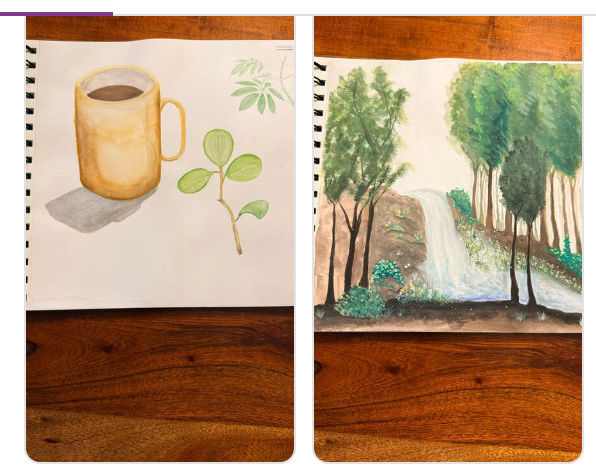
I also like playing with my dog, spending time with my husband and kid, and other friends and family. I do try to find some time to unwind and connect on things outside of work that also matter.
Your team did an escape room together. How did that go?
It was definitely one of my favorite things — as a self-described nerd, I love puzzle solving. I don't think it was for everyone, but I had a lot of fun working with the team, breaking into smaller groups, trying to figure out how to get out. I think you learn a lot about your co-workers in a different way.
We did escape — with zero time to spare. In our defense, a couple of things malfunctioned, so they had to help us through those parts.
The escape room also has some neat similarities to working at a startup: you have to row in the same direction, you need to be solving more than one problem at any given moment, and there's a clock ticking to get the job done.
You’ve been working to support the clean energy transition for almost your whole career. Where are we on that journey?
I think we still have a long way to go, but we've made a lot of progress. Today, there's no question that renewable energy technologies make sense economically. In a lot of places they are actually the only way to get new power-generating assets on the grid. And they may also be the only way to support all these data centers and other initiatives coming up that are going to require a lot of energy resources in the US.

